 Condo Fees vs House Maintenance Fees
So you’re thinking about buying a condo because you’ve heard they cost less than new build homes or freehold townhouses?
OK, but before making your final decision, you should at least look beyond the purchase price and investigate the monthly costs of condo ownership, and how much those costs can add up to over 25 years.
Readers note: Condo owners do not get their accumulated condo fees back when they sell the condo or pay off their mortgage.
A Condo Can Appear More Affordable But…
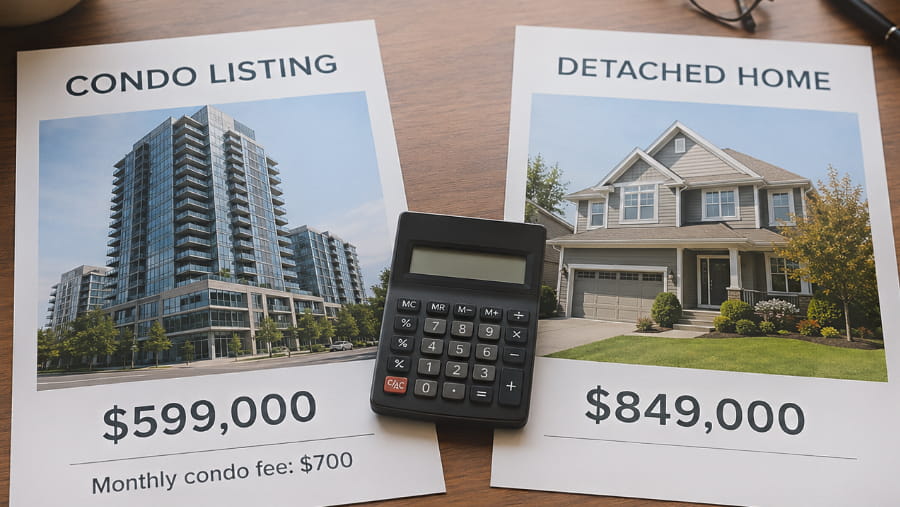
At first glance a condo can appear to be more affordable than home ownership because condos generally sell for less than detached homes. That is true, but the lower sticker price does not actually mean lower overall costs.
Most people don’t know that monthly condo fees are paid in addition to the mortgage, and property taxes, insurance and any expenses not covered by the fee.
A 25 year mortgage example
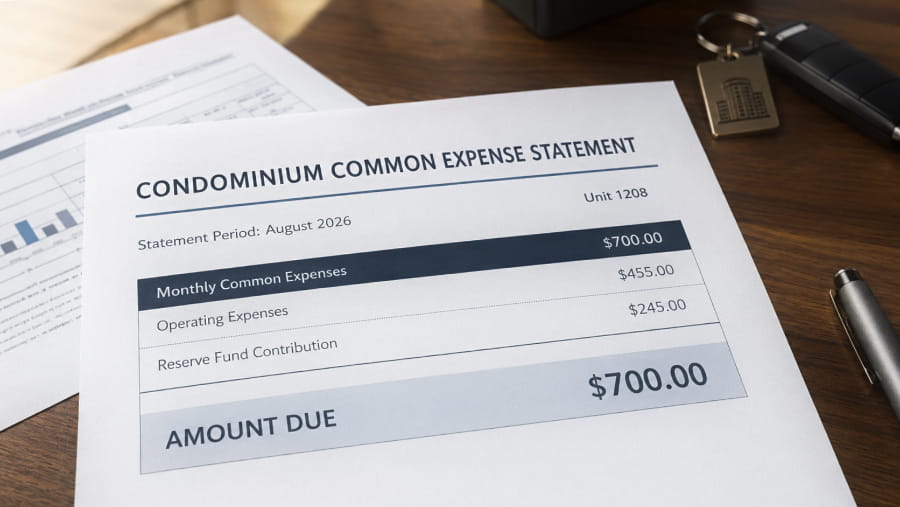
For instance, even if the fee never increases, a $700 monthly condo fee adds up to $8,400 per year and $210,000 over 25 years. Over those 25 years, none of those payments reduce your mortgage balance nor builds equity in your unit.
It’s not advised to treat a condo’s lower purchase as affordable factor while ignoring what would amount to an additional $210,000 in mandatory payments – again, only if the fee never increases.
Now consider if that same $700 were invested each month in a diversified equity index fund and earned a hypothetical average annual return of 10.5 per cent, it could grow to just over $1 million dollars.
There is no final condo fee payment
 When it comes to condo fees, there’s also no final condo-fee payment. The expense continues and continues for as long as you own the unit, even after the mortgage has been paid off.
Here’s a quick-glance list of the long-term financial realities to consider before buying a condo:
- Monthly condo fees are paid in addition to your mortgage.
- A $700 fee equals $8,400 per year and $210,000 over 25 years.
- With average annual increases of 3%, that total becomes approximately $306,000.
- Condo-fee payments do not directly build equity.
- Owners cannot recover their accumulated payments.
- Fees continue after the mortgage has been paid off.
- Owners have limited control over how the money is spent.
- Special assessments can result in additional bills.
- Property taxes, insurance and maintenance remain your responsibility.
- Detached-home maintenance could cost substantially less.
- Maintenance protects a home’s value, and improvements increase it.
Condo owners remain responsible
Here’s another important point to consider: condo owners are responsible for many of the repairs and replacements inside their own units. The example $700 fee does not necessarily cover appliances, flooring, fixtures, interior plumbing and so forth. An owner could therefore pay $210,000 in condo fees over 25 years and still incur substantial maintenance and renovation costs.
A detached homeowner on the other hand may spend considerably less than $700 on maintenance over several months and has greater control over if and when work is completed, who does it and how much it costs.
Condo owners must pay the full fee every month regardless of how much visible maintenance was performed. But with a detached home, that maintenance cost goes directly to the home. A condo fee can and usually goes toward costs related to the whole property.
Detached home maintenance costs are likely to be substantially cheaper over 25 years
Depending on the property’s age and condition, necessary maintenance on a detached home could be substantially cheaper over a 25 year period. Also, ordinary maintenance actually protects the home’s value and certain repairs and improvements can increase its resale value. That’s an obvious win-win over condo fees any day.
The bottom line is, that $210,000 fee represents a compulsory expense that doesn’t build equity, continues after the mortgage is paid and gives the owner very limited control over how the money is spent.
The Financial Pitfall of the Monthly Condo Fee
Is a Condo Fee Another Mortgage?
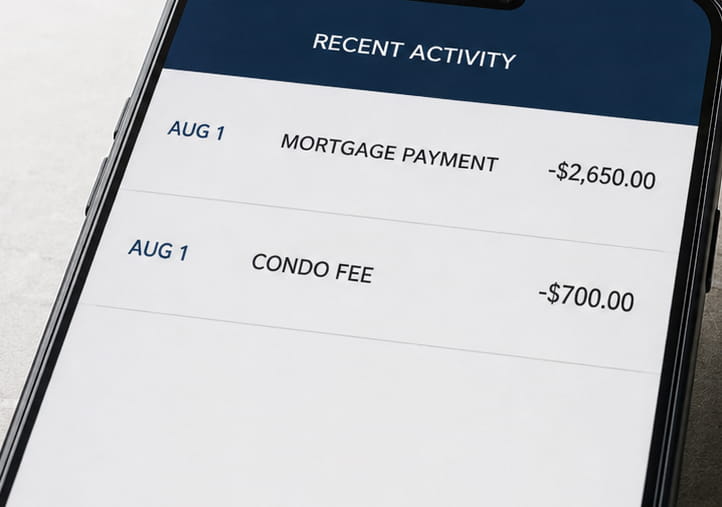 It sure looks like one. A condo fee is technically not another mortgage but it can definitely feel like one when the payment leaves your bank account every month.
The difference is with a house, the principal portion of the mortgage increases your equity but condo fees pay for current operating expenses and maintenance needs.
Depending on the building, condo expenses may include:
- Cleaning and maintaining common areas
- Landscaping and snow removal
- Elevator operation and servicing
- Property management and security
- Common utilities and the condominium corporation’s insurance
- Amenities such as pools, gyms and party rooms
- Contributions to the condominium reserve fund
These are legitimate expenses, but paying the fee does not build equity in your unit or reduce your mortgage balance.
Plus, you also have to pay the full amount every month even if no major upgrades are happening and you make no use of the amenities.
A $700 Condo Fee Can Accumulate to More Than $210,000
The simplest calculation is already an eye-opener:
$700 per month equals $8,400 per year or $210,000 over 25 years.
That’s just a calculation that assumes the fee never increases. The reality is that condo fees can and usually do rise as labour, insurance, utilities and building-repair costs become more expensive.
A fee that begins at $700 per month or even only $400 per month is unlikely to remain the same for the next 25 or 30 years. At an average annual increase of say 2-3%, the total can reach approximately $306,000 over 25 years.
That’s a problem because the recurring expense erases a meaningful portion of the price-point that originally attracted the buyer to the condo. The facts are pretty clear that a lower purchase price usually does not necessarily produce a lower overall cost once the condo fees and other expenses considered together.
The CMHC Condominium Buyers’ Guide advises buyers to include condo fees when calculating their complete monthly housing costs.
Condo Owners Have Limited Control Over the Bill
A detached homeowner can obtain another quote, postpone a non-urgent project or complete some work personally but condo owners on the other hand must participate in a shared financial structure where the corporation establishes the budget and every unit must contribute its assigned portion.
Owners can raise concerns about spending but no one can opt out of landscaping, property management, elevator repairs, security or an amenity they never use.
The fee is mandatory and unpaid fees can result in the condominium corp. placing a lien against the unit. Not good.
The Monthly Condo Fee May Not Be the Final Bill
Condo fees are intended to cover operating expenses and contribute to a reserve fund but paying into a reserve fund does not eliminate every financial risk.
If the corporation experiences a substantial budget shortfall or an unexpected expense where available funds are not enough to cover, owners can face a special assessment on top of their regular fees.
The Condominium Authority of Ontario explains that special assessments can result from unforeseen expenses or projects that cost more than what was budgeted.
The amount depends on the size of the shortfall and the owner’s assigned share. So whatever the total is it becomes another mandatory payment where refusing to pay can also result in a lien against the unit.
Regularly paying the monthly condo fee does not guarantee that the owner will never receive an additional bill.
Your Opportunities Without the Monthly Condo Fee
Put your money elsewhere
When it comes to condo fees, potential buyers should also consider the opportunity-cost of what that money could accomplish elsewhere.
A buyer choosing a property without a $700 monthly fee would not automatically have the entire amount left over but any monthly savings that remain can be used to reduce debt, add to a repair fund, improve the property or invest for the future.
Pay down the mortgage faster
You can reduce the principal sooner and lower the interest paid over the life of the loan by applying extra money to an eligible mortgage prepayment plan.
The exact savings depend on several factors but the practical benefit is that the extra money reduces a debt attached to an asset you own rather than disappearing into a recurring fee.
You an invest in the property
 Detached homeowners still need to budget for maintenance but these costs do not normally arrive as an identical bill each month. A homeowner can save during quieter periods and look for competing quotes for future jobs that need to be done – all while being in control of where the money should be spent.
Also, sensible work can make the home more comfortable, reduce operating costs and protect or potentially increase its resale value.
Of course not every repair or renovation produces a dollar-for-dollar return but the owner has a tangible improvement to show for the expense they paid and considerably more control over the decision.
You can invest the difference
Investing all or even some of the monthly difference also demonstrates a potential opportunity cost.
Let’s say the full $700 were invested every month and earned a hypothetical average annual return of five per cent, the contributions could grow to approximately $417,000 over 25 years. That’s a wallop!
That’s just an illustration of the potential rather than a guaranteed result but it demonstrates why a recurring housing expense should not be dismissed as “only $700 a month.”
How to Compare the Complete Cost Before Buying
Before deciding that a condo is more affordable than a detached home build, multiply the current monthly fee over the expected ownership period. Account for reasonable increases, determine exactly what the fee covers and review the corporation’s operating budget and reserve-fund position.
Compare that amount with the purchase price, mortgage and expected maintenance costs of a suitable new freehold home. And keep in mind that every property requires money for upkeep, but freehold ownership provides greater control over the timing, cost and priorities, and generally returns as an investment in the home.
The listing price should only be the beginning of the affordability calculation.